Take on DTE
Push down household energy costs and hold utility monopolies accountable for the rates and reliability families are forced to accept.
Threatens utility-company power.
Read the attack differently
“I’m not running for Congress because I’m a millionaire or a billionaire. I’m running because I’m not.”1
The opposition wants this race to be about a label. Donavan McKinney wants it to be about a question: who is he willing to fight — and who wins when he does? He refuses corporate PAC money to represent the people who work for a living, pay the bills, and feel it when corporations write the rules.12
Why the attack exists
He picked three fights the powerful would rather he hadn’t — each one aimed at a different center of concentrated power.
Push down household energy costs and hold utility monopolies accountable for the rates and reliability families are forced to accept.
Threatens utility-company power.Treat health care as a human right and end insurers’ power to decide whether a family gets the care it needs.
Threatens insurance-company power.Reject corporate PAC money and curb the influence utilities, insurers and their lobbyists buy in Washington.
Threatens corporate political power.Take on power like that, and the powerful run the same old playbook every time:
Donavan rejects corporate PAC money and says out loud which utilities and insurers he intends to take on.
Nobody owns his vote.A representative who can’t be bought puts rate hikes, coverage denials and quiet corporate arrangements at risk.
So the pushback begins.Flatten a complicated record into a slogan, ring his name with donor logos, and hope you argue about the label instead of the fights.
The attack is the proof.Why this fight is personal
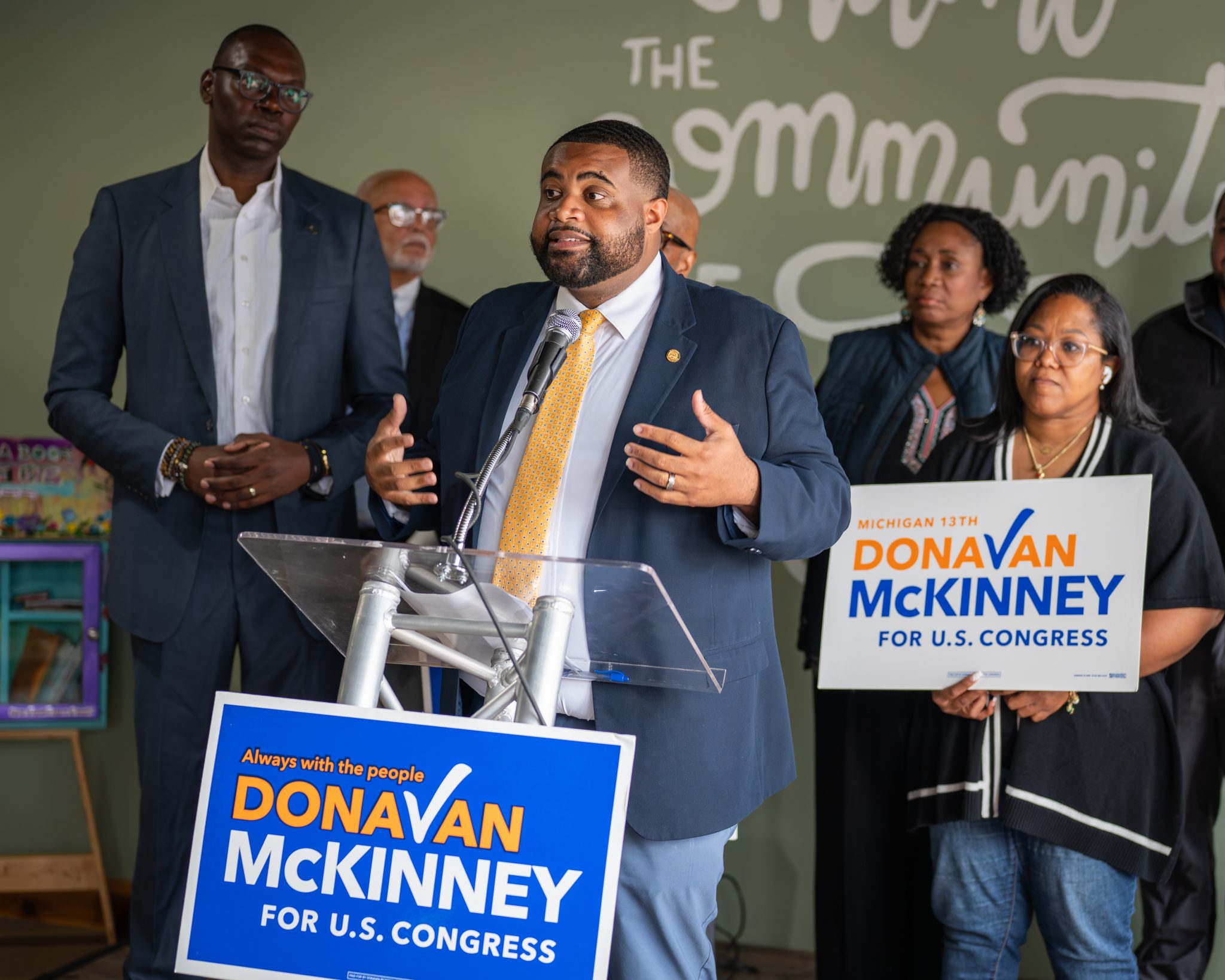
McKinney grew up in poverty in northeast Detroit, was raised by his mother and grandmother, faced repeated evictions and moved more than 13 times. After graduating from the University of Michigan, McKinney continued to serve residents, for the Community Development Advocates of Michigan (CDAD), at Wayne County Community College and through coalition-building work with SEIU Healthcare Michigan. He further dedicated his life to serving the public when he was elected to the state Legislature in 2022.1
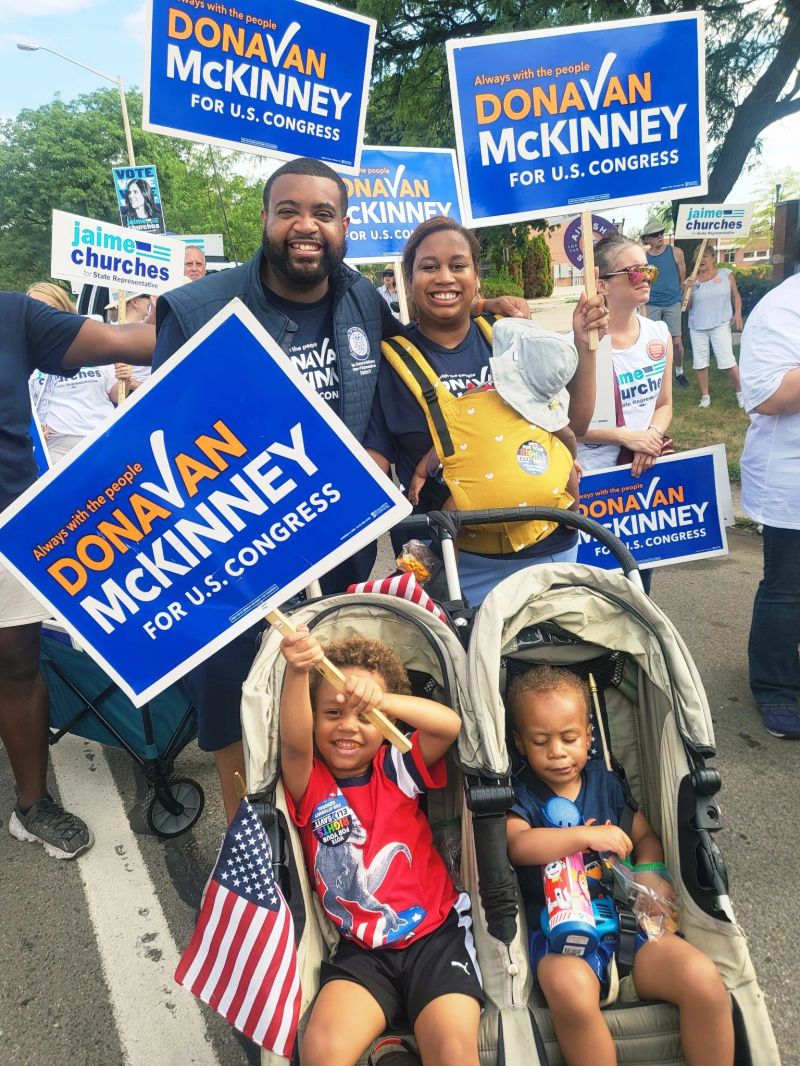
He isn’t taking on corporate power as a talking point. He grew up on the losing end of it — and decided to spend his career changing the odds.
He’s not saying it alone
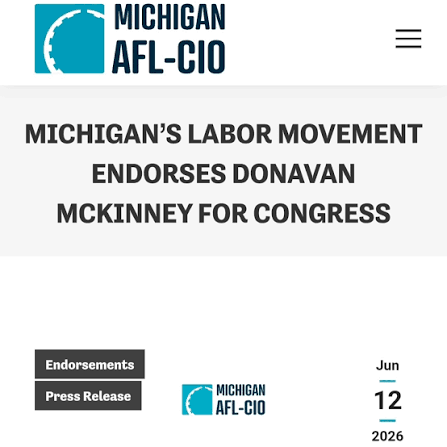
“Unionism runs through Donavan McKinney’s veins, and we know he’ll put workers first.”3
Ron Bieber, president of the Michigan AFL-CIO, in the federation’s June 12, 2026 endorsement.
“The Michigan Chronicle believes Donavan McKinney is the best prepared candidate to meet that moment.”4
Michigan Chronicle Editorial Board, July 15, 2026, after describing rising costs, housing instability, aging infrastructure, underfunded schools and economic insecurity as the issues that should define the election.
He’s already doing it
A campaign promise tells you what a candidate says he will do. A public record shows what he does when he already has power.
The pattern in Lansing is consistent: challenge concentrated power, lower household costs and make public institutions answer to the public.
McKinney was a sponsor of bills in the Taking Back Our Power package. In announcing the package, he said companies should not be allowed to buy influence and escape accountability.5
McKinney unveiled the Affordable Community Clean Energy Savings and Solar Act with environmental-justice advocates, arguing that community solar can lower utility bills, improve grid resilience and create union jobs.6
After severe storms left thousands without power, McKinney called for House Bills 4973-4978 to receive a vote, saying families deserve affordable, reliable energy and real protection from high prices and poor service.7
Michigan legislative records identify McKinney as the sponsor of House Bill 5089 of 2023, which proposed a water-rate affordability fund. He also co-sponsored the companion bill creating a broader water-rate affordability program.8
McKinney's official budget summary lists district and statewide investments in lead-service-line replacement, water affordability, housing, Medicaid, school meals, mental health, parks, transit and community violence intervention.9
This is not a new posture created for a congressional campaign. It is the same direction McKinney has already taken in Lansing: lower costs, challenge concentrated power and make government answer to the public.
The tell
When you challenge power, power pushes back. Now you know who’s pushing — and why.
Look at who his agenda would challenge. Then draw your own conclusion.
Support Donavan McKinney